


Building English as a Second Language for 5–6-Year-Old Children Through Teacher–Family Partnership: Practical Strategies and Activities at Hoa Phượng Preschool

Ths.Nguyễn Thị Phương Mai – Bộ môn Tiếng Anh
I. Introduction
In today's increasingly interconnected world, English has become an essential tool for communication, learning, and future career development. Recognizing this reality, Vietnam has placed growing emphasis on introducing English at the preschool level to provide children with early and meaningful exposure to the language. Research in early childhood education suggests that children aged five to six are particularly receptive to acquiring a second language because of their natural curiosity, cognitive flexibility, and willingness to learn through play, songs, stories, and everyday interactions.
However, successful second-language acquisition in early childhood cannot rely solely on classroom instruction. Young children learn most effectively when they experience consistent language exposure across different environments. Therefore, establishing a strong partnership between teachers and families is essential. While teachers provide professional guidance, structured learning experiences, and developmentally appropriate activities, families reinforce learning through daily communication, encouragement, and authentic opportunities to use English at home. Together, they create a rich and supportive language environment that nurtures children's confidence, motivation, and communication skills.
At Hoa Phượng Preschool, developing this partnership has become an important strategy for enhancing the quality of English education for children aged 5–6. Through regular communication with parents, home-based learning activities, family English events, and the effective use of digital technology, the school seeks to extend children's English learning beyond the classroom and make language acquisition a natural part of their everyday lives. This article discusses three key aspects of teacher–family collaboration in early English education.
II. Content
1. The importance of this partnership
* Creates a Consistent Language Environment
When parents reinforce the vocabulary, songs, and expressions introduced at school, children hear and use English more frequently. This consistency helps them remember new words and develop confidence in using English.
* Increases Exposure to English
Young children need regular exposure to a language to acquire it naturally. Since classroom time is limited, families can extend learning by reading picture books, singing songs, playing games, or using simple English during everyday routines at home.
* Builds Children's Confidence and Motivation
Children feel more secure when the important adults in their lives encourage the same learning goals. Positive feedback from both teachers and parents motivates children to participate actively and enjoy learning English without fear of making mistakes.
* Supports Learning Through Play
Children aged 5–6 learn best through play. Teachers can suggest simple home activities such as storytelling, role-playing, puzzles, or scavenger hunts in English. These playful experiences strengthen language skills while maintaining children's interest.
* Meets Individual Learning Needs
Regular communication between teachers and families helps identify each child's strengths, interests, and challenges. Teachers can recommend suitable activities, while parents can share observations from home, allowing learning to be better tailored to the child.
* Encourages Holistic Development
Learning English is not only about vocabulary and grammar. It also develops communication skills, creativity, critical thinking, social interaction, and cultural awareness. Cooperation between school and family supports children's overall cognitive, emotional, and social development.
* Establishes Positive Learning Habits
When families participate in English learning, children begin to view learning as a natural part of daily life. Simple routines, such as reading an English story before bedtime or singing an English song during playtime, foster lifelong learning habits.
* Strengthens School–Family Relationships
Partnerships between teachers and families build trust and encourage regular communication. Parents become more confident in supporting their children's learning, while teachers gain valuable insights into children's home experiences and progress.
2. Effective Ways to Create a Teacher–Family Partnership in Building English as a Second Language
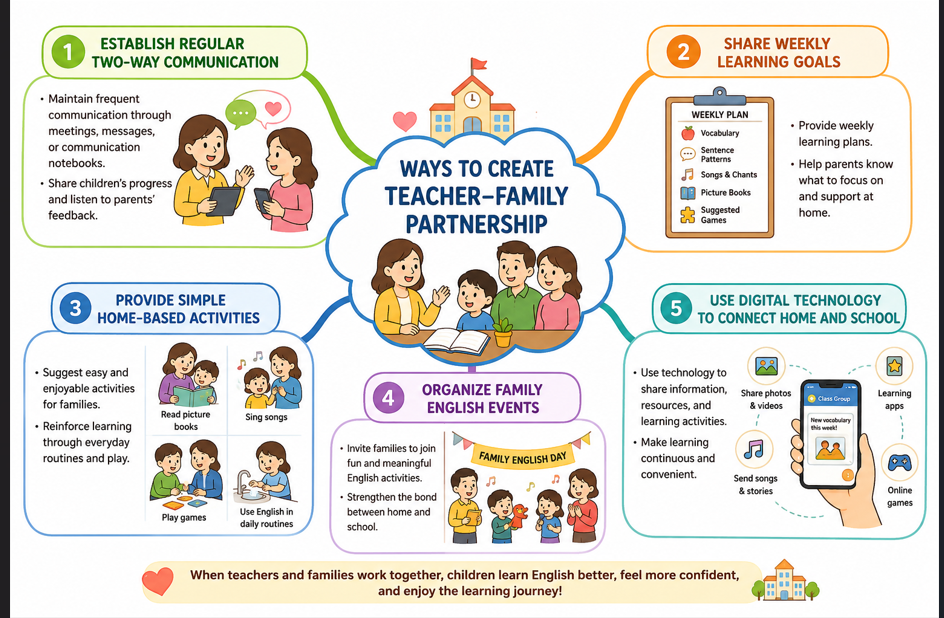
* Establish Regular Two-Way Communication
Teachers should maintain frequent communication with families through parent meetings, communication notebooks, messaging applications (e.g., Zalo, WhatsApp), or school websites. Parents can share their children's interests and progress, while teachers provide feedback and suggestions for home learning.
Example: Every Friday, teachers send a short message introducing the vocabulary and songs learned during the week, together with simple activities parents can do at home.
* Share Weekly Learning Goals
Parents are more willing to support their children when they know what is being taught. Teachers can provide a weekly learning plan including: target vocabulary; sentence patterns; songs and chants; picture books; suggested games for home practice. This allows parents to reinforce classroom learning without feeling overwhelmed.
* Provide Simple Home-Based Activities
Parents do not need advanced English skills. Teachers can recommend enjoyable activities that fit naturally into family routines, such as: Reading picture books together; singing English songs; naming household objects; playing vocabulary games; watching short educational videos; using English during daily routines ("Wash your hands," "Let's eat," "Good night."). These activities increase meaningful exposure to English.
* Organize Family English Events
Schools can invite families to participate in English-related activities such as: Family English Day; Storytelling festivals; Puppet shows; Singing competitions ; English play stations; Book fairs. These events make English learning enjoyable while strengthening home–school relationships.
* Use Digital Technology to Connect Home and School
Technology makes communication faster and more engaging. Teachers can:
- Share short classroom videos.
- Upload pronunciation recordings.
- Recommend educational apps.
- Create QR codes linking to songs or stories.
- Share digital flashcards or interactive games.
Parents can easily continue learning activities at home.
3. Activities for creating a Teacher–Family Partnership in Building English as a Second Language designed for 5-6-year-old kids in Hoa Phượng Preschool
3.1. Topic: My Body - Activity: "Build My Funny Body"
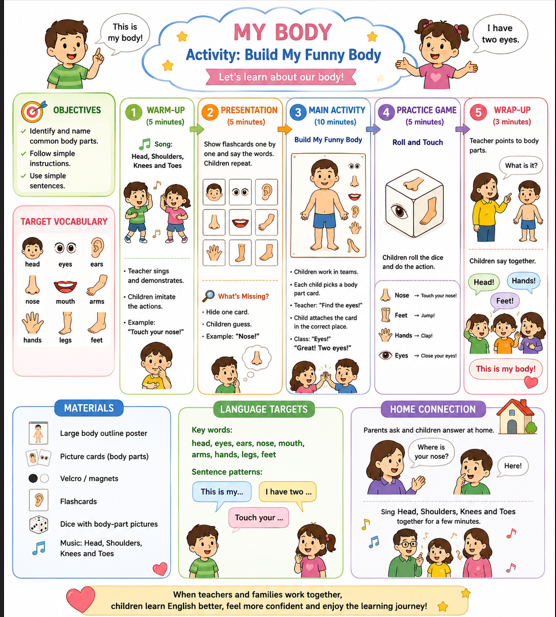
* Learning objectives: By the end of the activity, children will be able to: Identify and name common body parts:head, eyes, ears, nose, mouth, arms, hands, legs, feet; Follow simple English instructions; Use simple sentence patterns: This is my...; I have two...; Touch your...
* Materials: Large body outline poster; Picture cards of body parts; Velcro or magnets; Flashcards; Music: Head, Shoulders, Knees and Toes; Dice with body-part pictures (optional)
* Procedure
Warm-up
| Presentation
| Main Activity: Build My Funny Body
| Practice Game: Roll and Touch
|
Song: Head, Shoulders, Knees and Toes Teacher sings and demonstrates the actions. Children imitate the movements. Teacher asks: "Where is your nose?" Children touch their noses. Teacher continues: "Touch your ears!"
| Show flashcards one by one. Teacher: "This is a head." Children repeat. Continue with: eyes - ears - nose - mouth - arms - hands - legs - feet Play "What's Missing?" Children close their eyes. Teacher hides one flashcard. Children guess: "Nose!"
| Place a large body outline on the board. Divide children into two teams. Each child picks one body-part card. Teacher says: "Find the eyes!" The child runs to the poster and attaches the correct picture. Teacher asks: "What is it?" Child answers: "Eyes." Teacher encourages: "Great! Two eyes!" ... | Children roll a picture dice. Whatever appears, they perform. Examples: 🎲 Nose 🎲 Feet 🎲 Hands 🎲 Eyes
|
* Home Connection (Teacher–Family Partnership)
Parents receive a small worksheet showing a child.
At home, parents ask:
"Where is your nose?"
Child points and answers.
Parents then sing Head, Shoulders, Knees and Toes together for five minutes.
This simple activity reinforces classroom learning through enjoyable family interaction
3.2. English Family Event - Theme: "Yummy English Café!"
Learning English Through Food and Drinks
* Participants
- 5–6-year-old children
- Parents or grandparents
- English teachers
- Preschool teachers
* Objectives: Children will:
- Recognize and use English vocabulary related to food and drinks.
- Practice simple conversations in meaningful contexts.
- Develop confidence in speaking English.
- Strengthen teacher–family partnerships through play.
* Programme
🍎 Welcome to the English Café
Teachers decorate the classroom like a café or mini food market.
Families receive:
- A Food Passport
- Toy money
- A shopping bag
Teacher greets everyone: Welcome to Yummy English Café!
Children wear chef hats or fruit headbands.
🍌 Warm-up
Song: Do You Like Broccoli Ice Cream? (Super Simple Songs)
Children and parents sing together and do actions.
Teacher asks: Do you like apples?
Children answer: Yes, I do! Or No, I don't!
🍓 English Learning Stations
🍕 Station 1: Little Chef
Children "cook" a healthy meal using toy food or laminated food cards.
Vocabulary: apple, banana, rice, egg, milk, juice, bread, fish,
Sentence patterns: I like.../ I don't like.../ This is an apple.
Parents help children make a "healthy plate."
🍔 Station 2: English Café (Role Play)
Children become customers.
Parents become waiters.
Teacher provides simple menus.
Dialogue
Waiter: Hello!
Customer: I'd like some juice, please.
Waiter: Here you are.
Customer: Thank you.
🥕 Station 3: Healthy Basket Relay
Two families compete.
Teacher says: Find a carrot!/ Find some milk!
Children run to collect the correct food.
The first team wins a sticker.
🍉 Station 4: Taste and Guess
Children close their eyes.
Parents give tiny pieces of fruit (or picture cards if real food is unavailable).
Children guess: Apple!
Teacher asks: Is it sweet?
Children answer: Yes! Or No!
🍰 Station 5: Build My Healthy Plate
Children receive paper plates.
They choose food pictures.
Teacher asks: What do you have?
Children answer: I have rice and fish.
Teacher encourages healthy choices.
🍇 Family Challenge
Healthy Shopping Mission
Each family receives a shopping list.
Example: ✔ 2 apples/ ✔ 1 milk/ ✔ 3 bananas
Families find the correct food around the classroom.
Then they "pay" with toy money.
Teacher stamps the passport.
Language Targets: Vocabulary
🍎 apple 🍌 banana 🍊 orange 🥕 carrot 🍞 bread
🥛 milk 🧃 juice 🍚 rice 🥚 egg 🐟 fish
Sentence Patterns
I like... /I don't like.../I'd like...
Here you are.
Thank you.
What's this? - It's an apple.
Parent Involvement
Parents:
- Speak simple English during each activity.
- Encourage children rather than correcting every mistake.
- Praise children's effort.
- Join games and role-play naturally.
Teachers:
- Model the language.
- Support communication.
- Give positive feedback.
- Explain how families can continue practicing food vocabulary at home.
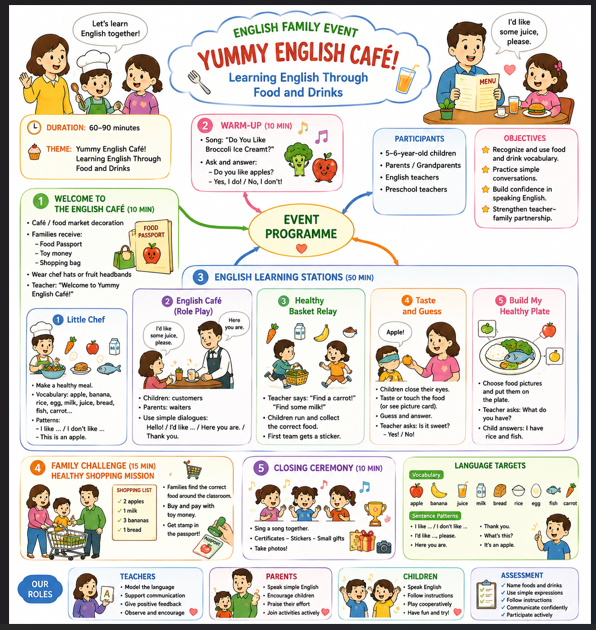
This event is highly suitable for a preschool setting because it combines role play, movement, games, and authentic communication. It also gives parents practical experience supporting their children's English learning in a fun, low-pressure environment, reinforcing the teacher–family partnership.
III. Conclusion
Building English as a second language for preschool children is a long-term educational process that requires collaboration between schools and families. For children aged 5–6, language learning is most effective when English is experienced naturally through meaningful communication, play, exploration, and positive interactions in both classroom and home environments. A strong teacher–family partnership provides children with consistent language exposure, emotional encouragement, and authentic opportunities to practice English beyond formal lessons.
The strategies presented in this article—including regular two-way communication, shared learning goals, home-based language activities, family English events, and the integration of digital technology—demonstrate practical ways to strengthen collaboration between teachers and parents. When families understand how young children learn languages and actively participate in the learning process, they become valuable partners in supporting children's linguistic, cognitive, and social development.
The activities implemented at Hoa Phượng Preschool illustrate how this partnership can be transformed into engaging learning experiences that promote children's confidence, communication skills, and enthusiasm for English. Through learning together in enjoyable and meaningful contexts, children not only develop foundational English skills but also build positive attitudes toward lifelong learning.
As early childhood education continues to evolve in response to globalization and educational innovation, strengthening teacher–family partnerships will remain a key factor in improving the quality of English education. It is hoped that the experiences shared in this article will provide useful references for preschool educators and parents seeking to create supportive, child-centered environments in which young learners can acquire English naturally, confidently, and joyfully.
References
- Epstein, J. L. (2018). School, Family, and Community Partnerships: Preparing Educators and Improving Schools (3rd ed.). Routledge.
- NAEYC. (2020). Developmentally Appropriate Practice Position Statement.
- Cummins, J. (2000). Language, Power and Pedagogy. Multilingual Matters.