


Creating a Positive English Classroom: Classroom Management Strategies for Preschool Children at Hoa Phuong Preschool

Th.s Nguyễn Thị Phương Mai - Bộ môn Tiếng Anh
Introduction
The preschool years provide an ideal foundation for children to begin learning English. At the age of 5–6, children are naturally curious, eager to communicate, and learn best through play and meaningful interactions. However, successful English learning depends not only on engaging activities but also on a positive and well-managed classroom environment.
At Hoa Phượng Preschool, classroom management is more than maintaining order. It is about creating a safe, supportive, and joyful learning environment where children feel confident to explore, participate, and communicate in English. Through clear routines, positive encouragement, and play-based learning, our teachers help children develop language skills while fostering confidence, independence, and a love of learning.
This article highlights the importance of classroom management in English lessons and shares practical strategies used at Hoa Phượng Preschool to support Vietnamese children aged 5–6 in learning English effectively.
1. Understanding Our Learners: Characteristics of Vietnamese 5–6-Year-Old Children Learning English
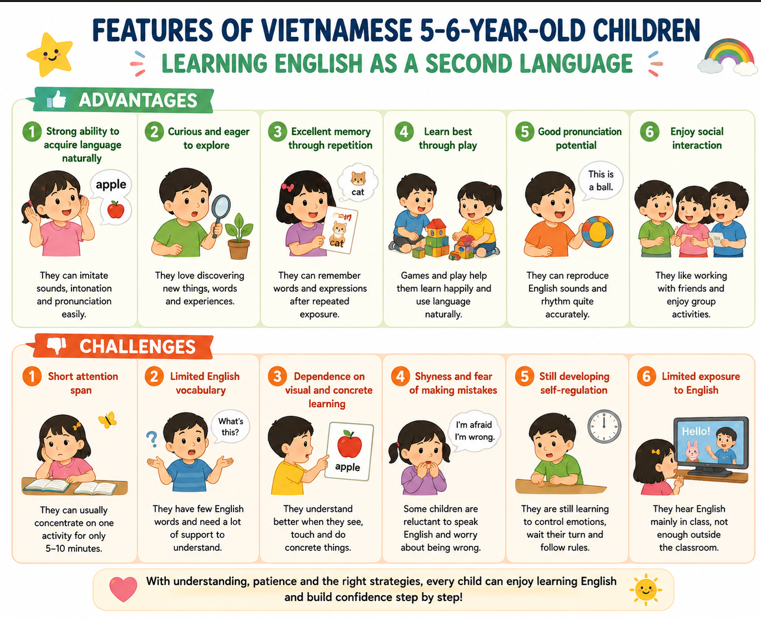
For Vietnamese children aged 5–6 learning English as a foreign language, understanding their developmental characteristics helps teachers choose appropriate teaching methods and classroom management strategies. Here are the advantaguous and disadvantaguous features of those kids
* Advantages:
+ Strong Ability to Acquire Language Naturally: Children aged 5–6 are in a sensitive period for language learning. They can imitate sounds, intonation, and pronunciation more easily than older learners.
Teaching implication: Use songs, chants, stories, and repeated listening activities to develop pronunciation and listening skills.
+ Curiosity and Willingness to Explore: Young children are naturally curious and enjoy discovering new words, games, and experiences.
Teaching implication: Introduce English through hands-on activities, experiments, role-play, and storytelling to maintain motivation.
+ Excellent Memory through Repetition: Although they may not understand grammar rules, children can remember words and expressions after repeated exposure.
Teaching implication: Recycle vocabulary frequently through songs, games, classroom routines, and daily communication.
+ Learn Best through Play: Play is children's natural way of learning. Games reduce anxiety and encourage meaningful language use.
Teaching implication: Incorporate movement games, puzzles, role-play, and cooperative activities into every lesson.
+ Good Pronunciation Potential: Most children at this age can reproduce English sounds and rhythm with relatively accurate pronunciation if they receive regular exposure.
Teaching implication: Provide rich listening input from teachers, songs, and age-appropriate audio materials.
+ Enjoy Social Interaction: Children like working with classmates and enjoy participating in group activities.
Teaching implication: Use pair work, group games, and collaborative tasks to promote communication and social development.
* Challenges:
+ Limited Attention Span: Children can usually concentrate on one activity for only about 5–10 minutes.
Teaching implication: Change activities frequently and alternate between active and quiet tasks.
+ Limited English Vocabulary: Most Vietnamese preschool children have little or no English exposure outside the classroom.
Teaching implication: Introduce a small number of new words (around 5–8 per lesson) and support understanding with pictures, gestures, and real objects.
+ Dependence on Visual and Concrete Learning: Children at this age think concretely rather than abstractly. They have difficulty understanding explanations without visual support.
Teaching implication: Use flashcards, puppets, toys, real objects, videos, and demonstrations instead of lengthy verbal explanations.
+ Shyness and Fear of Making Mistakes: Some Vietnamese children are reluctant to speak English because they worry about giving the wrong answer or being corrected.
Teaching implication: Praise effort, encourage participation, and create a supportive classroom atmosphere where mistakes are seen as part of learning.
+ Limited Exposure to English: Unlike children in English-speaking environments, Vietnamese children generally hear English only during lessons.
Teaching implication: Maximize English input in the classroom through songs, greetings, classroom language, and repeated exposure, while encouraging simple practice at home.
2. Why Classroom Management Matters
Classroom management is essential for teaching preschool children because it creates a safe, organized, and engaging environment where young learners can develop academically, socially, and emotionally. Unlike older students, preschool children have short attention spans, are still learning self-control, and need consistent guidance to participate effectively in classroom activities. Here are the main reasons why classroom management is so important in preschool education:
* Creates a Safe and Secure Learning Environment: Young children learn best when they feel safe and know what to expect. Clear classroom rules, routines, and teacher guidance help reduce anxiety and create a sense of security.
Example: Children know that after circle time comes story time, then playtime, making them feel confident and comfortable.
* Encourages Positive Behaviour
Effective classroom management teaches children appropriate behaviours such as: Sharing toys; Taking turns; Listening to others; Following instructions; Respecting classmates. Instead of simply correcting misbehaviour, teachers reinforce positive actions through praise, encouragement, and modelling.
* Maximizes Learning Time: Without effective management, much of the lesson may be spent dealing with disruptions. Well-established routines allow children to move smoothly between activities, giving them more time to learn through play, songs, stories, and hands-on experiences.
* Supports Children's Social and Emotional Development: Preschool is often children's first experience in a group setting. Classroom management helps children learn to: Express their feelings appropriately; Cooperate with others; Solve simple conflicts; Develop empathy; Build self-confidence. These skills are essential for lifelong learning.
* Promotes Independence: Consistent routines encourage children to do simple tasks independently, such as:Putting away toys; Washing hands; Choosing learning centres; Cleaning up after activities. Independence builds responsibility and self-esteem.
* Reduces Challenging Behaviour: Many behavioural problems occur because children are bored, confused, or unsure of expectations. Effective classroom management minimizes these situations by: Giving clear instructions; Keeping children actively engaged; Providing age-appropriate activities; Using positive reinforcement
* Improves Teacher–Child Relationships: When teachers manage the classroom positively rather than relying on punishment, children feel respected and valued. Warm, trusting relationships encourage children to participate, ask questions, and enjoy learning.
* Supports Language Development: A well-managed classroom provides more opportunities for meaningful communication. Children can participate in songs, discussions, storytelling, and pair or group activities without frequent interruptions.
* Creates an Inclusive Learning Environment: Good classroom management ensures that every child—including shy children, children with different learning needs, or English language learners—has opportunities to participate and feel included.
* Builds the Foundation for Future School Success: Preschool classroom management helps children develop school readiness skills, including: Listening attentively; Following routines; Working with others; Managing emotions ; Staying focused on tasks. These habits prepare children for success in primary school and beyond.
3. Effective Classroom Management Strategies at Hoa Phượng Preschool
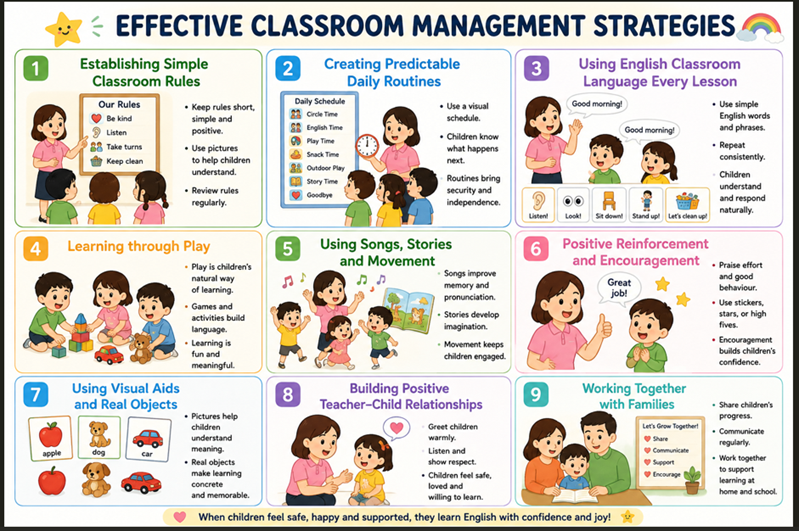
Managing a preschool classroom successfully requires a balance of structure, warmth, and engaging teaching. Young children (typically 3–6 years old) are naturally curious, energetic, and still developing self-regulation, so effective classroom management focuses on prevention rather than correction. Below are the ways
* Establish Clear and Simple Classroom Rules: Preschool children can only remember a few rules, so keep them short, positive, and easy to understand.
Examples: Use kind hands; Listen when someone is speaking; Walk inside the classroom; Share and take turns; Clean up after playing. Use pictures or symbols alongside the words so children can understand even if they cannot read.
* Create Predictable Daily Routines: Young children feel more secure when they know what will happen next. A typical routine may include: Greeting time; Circle time; English lesson; Learning centres; Snack time; Outdoor play; Story time; Goodbye song. Using a visual schedule with pictures helps children follow the day's activities independently.
* Build Positive Relationships: Children are more likely to cooperate when they feel loved, respected, and understood. Teachers should learn every child's name quickly; smile and greet each child warmly; listen patiently; encourage children's ideas; show empathy when children are upset. A caring relationship reduces many behaviour problems before they begin.
* Use Positive Reinforcement: Instead of focusing on inappropriate behaviour, praise the behaviour you want to see. For example: "Excellent listening, Anna!"; "I like how Minh is sitting quietly."; "Thank you for sharing your toys.". Rewards may include: Stickers; High-fives; Classroom helper roles; Praise during circle time. Positive reinforcement encourages children to repeat good behaviour.
* Keep Children Actively Engaged: Many behaviour problems occur when children become bored. Preschool lessons should include: songs; games; stories; movement activities; hands-on tasks; role-play; picture cards. For English lessons, change activities every 5–10 minutes to match children's attention spans.
* Give Clear and Simple Instructions: Children understand short directions better than long explanations. Instead of: "Everyone needs to stop what you're doing because we're going to clean everything up before moving to the next activity."
Say: "Stop." ; "Look at me."; "Put the blocks in the box."; "Then sit on the carpet."
Demonstrating the action while speaking makes instructions even clearer.
* Work Together with Families: Children benefit when teachers and parents use similar expectations. Teachers can: share classroom rules with parents; communicate children's progress regularly; suggest simple activities to reinforce positive behaviour at home; celebrate children's achievements together.
* Practical Example in an ESL Preschool Classroom
Imagine you are teaching colours to a class of five-year-olds.
- Begin with a greeting song to gain attention.
- Review the classroom rules using pictures.
- Introduce colour flashcards.
- Play "Touch Something Red."
- Read a short picture book about colours.
- Sing a movement song.
- Let children complete a colouring activity.
- End with a clean-up song and praise children who tidy up responsibly.
4. Classroom Management in Action at Hoa Phượng Preschool
While the principles of good preschool classroom management are universal, Vietnamese preschool children learning English as a foreign language (EFL) have some characteristics that require different management strategies. Their behaviour is influenced by their language level, educational culture, and learning experience.
Here are some important differences and practical suggestions.
General Preschool Classroom | Vietnamese Preschool English Classroom |
Children understand the teacher's language. | Children may not understand English instructions. |
Behaviour is managed mainly through verbal directions. | Teachers need gestures, pictures, demonstrations, and routines. |
Children can answer freely. | Many children are shy about speaking English or afraid of making mistakes. |
Activities focus on general learning. | Activities should maximize English exposure through games, songs, and movement. |
Teacher manages behaviour. | Teacher manages both behaviour and language comprehension. |
* Use More Non-verbal Communication: Because English is not the children's first language, they cannot always understand spoken instructions.
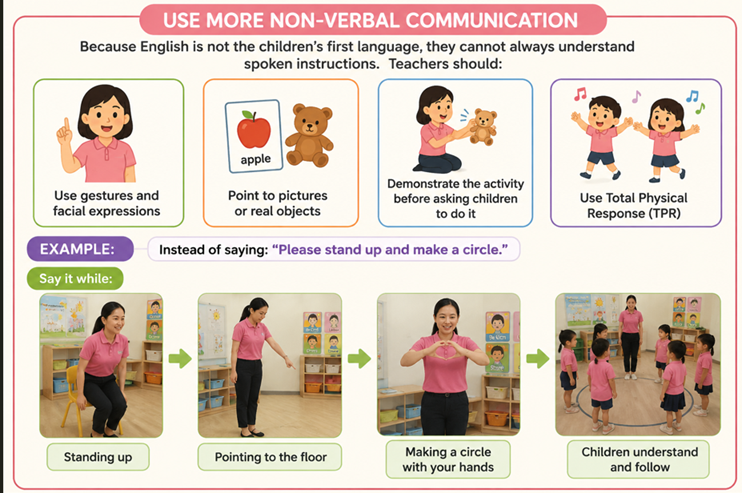
Teachers should use gestures and facial expressions; point to pictures or real objects; demonstrate the activity before asking children to do it; use Total Physical Response
Example: Instead of saying: "Please stand up and make a circle.". Say it while: standing up, pointing to the floor, making a circle with your hands. Children quickly understand through observation.
* Establish English Classroom Routines: Children learn classroom English through repetition. Use the same expressions every lesson, for example: Good morning! Sit down. Stand up. Listen. Look. Repeat. Show me... Hands up. Let's clean up. Goodbye! After several weeks, children respond automatically without translation.
* Keep Teacher Talking Time Short: Young learners cannot concentrate on long explanations, especially in a foreign language. Instead of explaining for several minutes: demonstrate, let children try, praise immediately. Aim for short instructions of one or two steps.
* Include Frequent Movement Activities: Vietnamese preschool children often have high energy levels and learn best through physical activity. Useful activities include Simon Says; Run and Touch; Find Something...; Action songs; Dancing; Passing games; Relay races. Movement helps maintain attention while reinforcing language.
* Use Visual Supports: Visuals help children understand meaning without relying on Vietnamese. Useful resources include flashcards, puppets, toys, picture books, real objects (realia), videos, classroom labels. The more visual support provided, the less translation is needed.
* Keep Activities Short: Attention spans are limited, especially when children are processing a new language. A good English lesson alternates activities every 5–8 minutes, such as: Greeting song; Flashcards; Game; Story ;Song; Craft; Goodbye routine. Frequent changes help sustain engagement.
* Communicate with Parents: Parents play an important role in reinforcing English learning. Teachers can suggest simple home activities, such as singing the class song together, reviewing five vocabulary words, reading a picture book, playing an English game for five minutes. Consistent exposure supports classroom learning.
* Additional Tips for Vietnamese Teachers of English at Hoa Phượng Preschool:
- Use English as much as possible, but support meaning with gestures, visuals, and demonstrations rather than frequent translation.
- Repeat key vocabulary naturally throughout the lesson.
- Introduce only a small number of new words (about 5–8 items) in one lesson.
- Balance active games with quieter activities to help children regulate their energy.
- Praise participation and effort as much as accuracy to encourage children to use English confidently.
Conclusion
Effective classroom management is the foundation of successful English learning in preschool education. For Vietnamese children aged 5–6, a positive and well-organized classroom provides the security and encouragement they need to develop confidence, curiosity, and communication skills. Through predictable routines, clear expectations, engaging play-based activities, and caring teacher–child relationships, children are able to learn English naturally while also developing important social and emotional competencies.
At Hoa Phượng Preschool, classroom management is viewed as an essential part of quality teaching rather than simply a way to control behaviour. Our teachers strive to create joyful learning experiences where every child feels respected, included, and inspired to participate. By integrating songs, stories, games, movement, and meaningful interactions into daily English lessons, we help children build a strong foundation for future language learning while nurturing creativity, independence, and a positive attitude towards school.
We also recognize that children's success is strengthened through close collaboration between teachers and families. By working together to provide consistent support both at school and at home, we can create an enriching English-learning environment that enables every child to reach their full potential. At Hoa Phượng Preschool, we are committed to helping every young learner grow into a confident, enthusiastic, and lifelong learner, one joyful English lesson at a time.
References