


Building English as a Second Language from the Preschool Years: The Hoa Phượng Preschool Experience

Thạc sĩ Nguyễn Thị Phương Mai - Bộ môn Ngoại ngữ
Introduction
In today's globalised world, English has become an essential tool for communication, learning, and international collaboration. Recognising its importance, the Vietnamese Government issued Decision No. 2371/QĐ-TTg (27 October 2025), which sets out the vision of gradually developing English as a second language in schools by 2035, with a vision towards 2045. Research consistently shows that the preschool years are the most favourable period for second-language acquisition. Children aged five to six learn naturally through listening, imitation, interaction, and play rather than through explicit grammar instruction. Therefore, achieving the goals of Decision No. 2371 begins with creating rich, meaningful English experiences in early childhood.
At Hoa Phượng Preschool of Bac Ninh Teacher Training College, we embrace this vision by creating a joyful, child-centred learning environment where English is used as a natural means of communication.
Our Approach
At Hoa Phượng Preschool, English is not treated as an isolated subject. Instead, our programme combines an English-rich environment, the My Little Fun curriculum, play-based learning, teacher expertise, and strong home–school partnerships to help children develop confidence, curiosity, and communicative competence.
Creating an English-Rich Environment
English is embedded into greetings, routines, songs, stories, games, classroom displays, and everyday interactions. Frequent exposure helps children acquire language naturally while building confidence.
Learning with My Little Fun
Our English programme is built around My Little Fun 3, an engaging course for five- and six-year-olds. Through songs, chants, stories, role-play, crafts, and games, children develop listening and speaking skills in meaningful contexts. The programme covers familiar themes including My Body, My Family, My Home, Food and Drinks, Animals, Colours and Shapes, Toys, Clothes, Weather and Seasons, and Transportation, allowing children to connect English with their everyday lives.
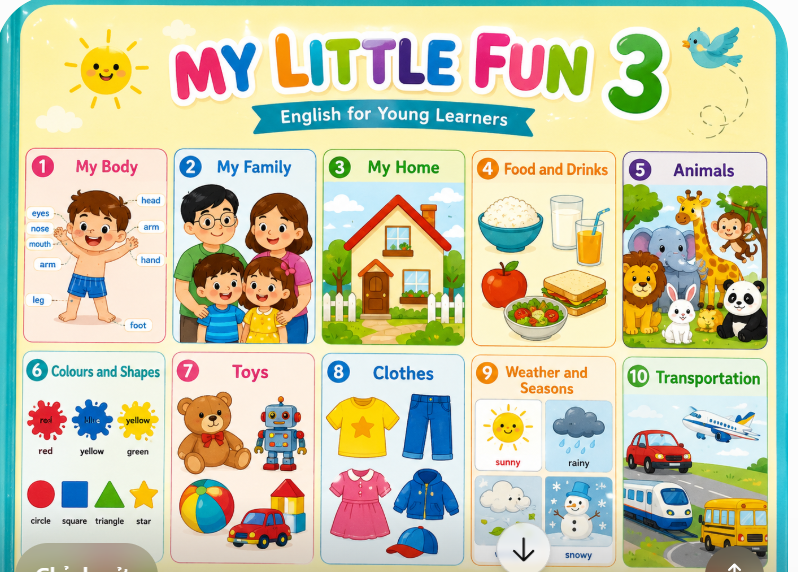
Each unit combines language learning with meaningful activities that encourage children to observe, explore, communicate, and collaborate. Rather than memorising vocabulary in isolation, children use English in authentic situations through play and interaction.
Following a child-centred and play-based approach, My Little Fun 3 also supports children's cognitive, social-emotional, creative, and physical development. By fostering curiosity, confidence, and a love of learning, the course provides a strong foundation for lifelong English learning.
Learning Through Play
Play is at the heart of early childhood education. Music, movement, storytelling, arts and crafts, science exploration, and imaginative play provide authentic opportunities for children to use English while developing creativity, collaboration, and critical thinking.
Here are some designed activites for the topics of Toys; Transportation and Animals
1. Topic: Toys
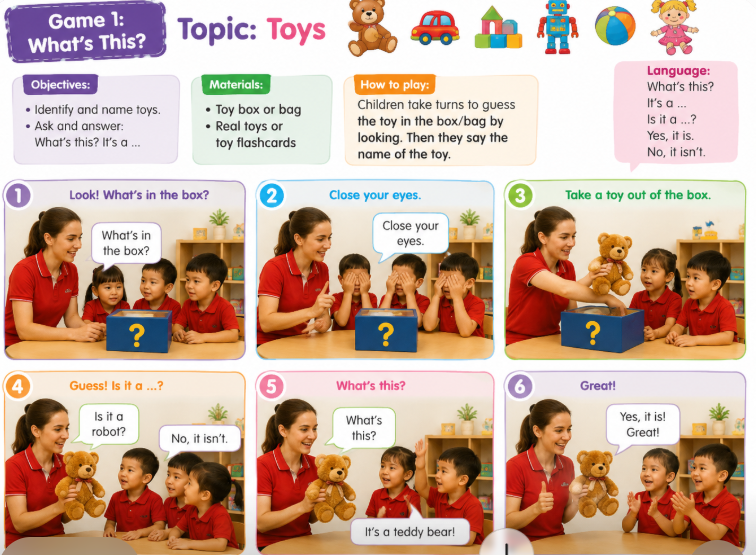
Activity 1: Mystery Toy Bag
Objective: Identify and describe toys using simple language.
Materials: A cloth bag and several toy objects (ball, teddy bear, robot, doll, car, kite, blocks).
How to play:
- One child reaches into the bag without looking.
- The child feels the toy and guesses:
- "Is it a teddy bear?"
- "I think it's a robot."
- The class answers:
- "Yes, it is!"
- "No, it isn't!"
- The child takes it out and says:
- "It's a teddy bear."
Language
- What's this?
- It's a...
- Is it a...?
- Yes, it is./No, it isn't.
Activity 2: Toy Shop Role-play
Create a mini toy shop.
Children take turns being:
- Shopkeeper
- Customer
Example dialogue:
Customer:
| Shopkeeper:
|
Hello! Can I have a robot, please? Thank you.
| Hello! Here you are. You're welcome.
|
This develops real-life communication while children enjoy pretend play.
2. Topic: Transportation
Activity 1: Traffic Light Game
Prepare three coloured circles:
- Red
- Yellow
- Green
Children pretend to drive different vehicles.
Teacher says:
Drive your bus!
Show Green → children move.
Yellow → slow down.
Red → Stop!
Then ask:
- What are you driving?
- I'm driving a bus.
Children love moving while speaking.
Activity 2: Vehicle Stations
Place pictures around the classroom.
Examples:
- airport
- train station
- harbour
- bus stop
Teacher says:
"Take the plane!"
Children run to the airport picture.
Next:
"Take the train!"
Variation:
Children work in pairs and ask each other:
How do you go to school?
By bus!
3. Topic: Animals
Activity 1: Guess the Animal
One child secretly picks an animal card.
He/she acts like the animal.
The class guesses.
Examples:
"It has a long neck."
"It's a giraffe!"
"It says woof woof."
"It's a dog!"
This encourages observation and speaking.
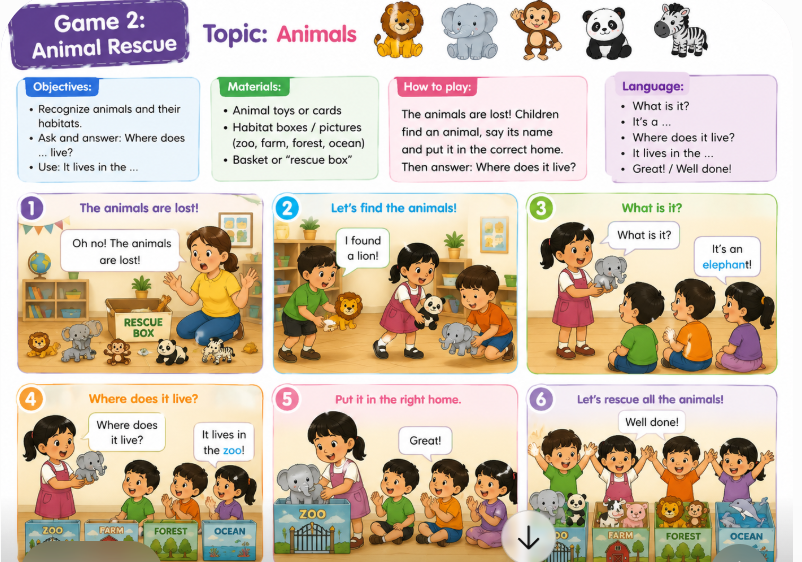
Activity 2: Animal Rescue
Hide animal toys around the classroom.
Tell children:
"Oh no! The animals are lost!"
Children search.
When they find one, they say:
"I found a tiger!"
"I found an elephant!"
Then place each animal in the correct habitat.
Forest
Farm
Ocean
Zoo
Teacher asks:
"Where does the elephant live?"
Children:
"It lives in the zoo."
Conclusion
Building English as a second language begins with joyful experiences rather than academic pressure. By combining an English-rich environment, the My Little Fun curriculum, play-based learning, skilled teachers, and supportive families, Hoa Phượng Preschool is laying a strong foundation for lifelong English learning. Every story, every song, every game, and every conversation helps children become confident communicators and prepares them for an increasingly connected world.